The next chapter of my journey has begun – I’m now taking an intermediate course for Nerikiri Wagashi taught by my instructor, Hiromi-sensei from Kobe, Japan. It’s been about 3 years since I last joined her online class, having first taken her begginer course in 2021!
What is Nerikiri Wagashi
Nerikiri wagashi is a type of traditional Japanese confectionary that often is served during traditional Japanese tea ceremony. These sweets are typically made with plant-based ingredients such as sweet white bean paste, glutinous rice flour, and sugar. The soft white bean dough, known as Nerikiri-an is shaped into intricate designs inspired by the beauty of nature and the changing seasons.
What makes Nerikiri Wagashi unique is that each design has a specific name, called “Kamei (菓銘)”, which often carries history and old poems, and can also be named after your own memories. Reflecting on the name of the sweet, and imagining what is expressed within the small sweet while enjoying a cup of tea… I think it is a beautiful way to enjoy Wagashi.
If you are planning to visit Japan, I highly recommend stopping by a traditional Japanese sweets shop. Many of them offer seasonal, limited-edition Nerikiri Wagashi. You can also join a Wagashi-making workshop for a hands-on experience. Check out programs in the area where you will be staying; these workshops are often hosted by locals or Wagashi shops and provide a wonderful opportunity!
Ok, now I’m going to show you Nerikiri Wagashi that I made for the lesson.
The first one is…
“Seifu Banri no Aki (清風万里の秋)“
The meaing is ”The refreshing breeze spanning thousands of miles, feeling the early autumn season of calmness and clarity stretching far and wide.”

The Nerikiri Wagashi design was a Hiromi-sensei original. She got the inspiration from an autumn dawn sky she saw a few years ago.
You might think this is very simple design, but it was actually the most difficult one to make. 

The 2nd one is…
“Fuyu Jitaku (冬支度)~Getting ready for winter~“
“Fuyu jitaku” is a seasonal word for the late autumn season in haiku; it also has the meaning of getting ready for winter.

My daughters loved this one so much! But when they saw it, they said “Is it a mushroom?”  I said “Nooo! This is a house called Inakaya, which means a Japanse country house.” I googled some pictures of Inakaya and showed to them. hehe
Speaking of Inakaya, I also showed my daughters a picture of Shirakawa-go village. Shirakawa-go is famous for its traditional Gassho-style housing. It forms a beautiful landscape that can be considered quintessential Japanese scenery. In 1976, the village was recoginaized as preservation District for Groups of Traditional Buildings and it was registered as a UNESCO World Heritage Site in 2015. We talked about our future trip to Shirakawa-go to see the Gassho-style housings. I’m the one who is most excited!

Gassho-style housing at Shirakawa-go, Gifu, Japan.
The last one is…
“Utsuroi Giku (移ろい菊)~Fading Chrysanthemum”

白菊や黄菊が急な寒さにあうと、霜焼けのような現象を起こして紫色に変色する。平安人たちは、これを「移ろい菊」と表現して大いに賞美した。
出典:八條忠基(2020)『有職の色彩図鑑 由来からまなぶ日本の伝統色』淡交社
This is a translation of the explanation listed above.
“The phenomenon where white or yellow chrysanthemums change to a purplish color when exposed to sudden cold, resembling frostbite. It was referred to as Utsuroi Giku, fading chrysanthemums, by people in the Heian period (794 to 1185 CE). They admired and celebrated the natural transformation greatly.”
I love the gradiation that Hiromo-sensei creates in her art of wagashi. It was really hard making the red and purple-ish color to represent the fading chrysnthemums.
Actually a day after I made the Utsuroi giku wagashi, I went to buy some groceries and stopped by a local store. And I saw a beautiful white and red chrysanthemum at the corner of the store. I wondered if this was Utsuroigiku that we learned during the lesson?

I cannot describe well, but I felt so grateful that I could encounter the chrysanthemum flower which might be the Utsuroi Giku in Shenyang.
The picture below is a failed one… the surface of the sweet got some cracks when I tried to fold it around the sweet red bean paste. Nerikiri Wagashi is so fragile and delicate…

When it’s time for Wagashi tasting, we always try to get together as a family at the table. This time, my daughters were glued to the screen and they were so slow coming to the table. But thanks to my husband! He always tell them “It’s time for mama’s Wagashi tasting! Please turn off the TV!” hehe He loves my Wagashi too!
Before the tasting, I always start with an explanation about today’s wagashi. My daughters were like “I wanna eat them soon! When can we start…?” hehe After I finished talking, we finally had the wagashi together. 🙂

I only make a few Nerikiri Wagashi since the ingredients for making them are limited and also it takes time to make them. So we always cut into four pieces and share with each other.

My youngest took a picture of my sweets below while I was boiling some water to make matcha tea. I think she did a great job! hehe


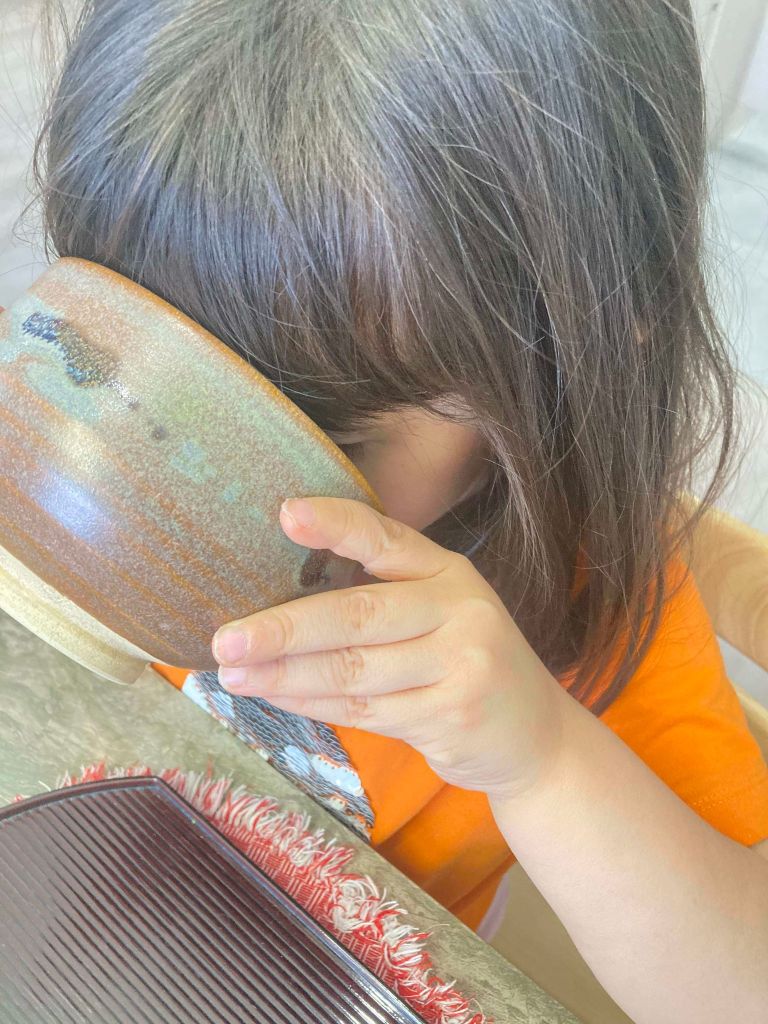
After my daughter sipped a bit of matcha, she said “It’s too bitter, but so yummy!”
When I was taking her picture, I felt how grown up my daughter is!

The picture below is of my daughter when she was about 1 and half years old. She was so tiny… hehe

Having Wagashi at the table is a very special moment for our family. It is also a time to reconnect with Japan and a time that we can talk about our culture.

My youngest was posing as a monkey! She was about 2 years old, I believe. hehe

Shenyang is actually warmer compared to last year around this time. And we can still enjoy the autumn season.


I hope you are enjoying the beautiful autumn season where you live.
Thank you for reading my blog post! 
 sachiwagashi.com