
I would like to write about our visit to Xishan Dragon Gate (西山龍門) last October. Xishan Dragon Gate is registered as the UNESCO’s world heritage site in Kunming, Yunnan province. It is a stone gate built during the Qing Dynasty on a moutain cliff that’s up to 2000m in elevation. We took a shuttle from the parking area to the hiking start, after riding about an hour in a taxi from our hotel.
Our tour guide asked us if we could see the dragon gate on top of the moutain. And I realized that “Oh, we have to hike up there to see the dragon gate…” I didn’t expect that it would be a hiking day. 

There is a word “登龙门” (dēng lóng mén) in Chinese or “登竜門” Torumon in Japanese. This word is very famous and most Japanese know it too. Its meaning is “Success to the gate.” The three Chinese charactors mean “dragon climing up the gate.” I was very excited to see the actual gate from which the story of this word originated from.
The dragon gate was caved on a stone cliff, taking 72 years to complete during the Qing Dynasty between 1781 and 1853.
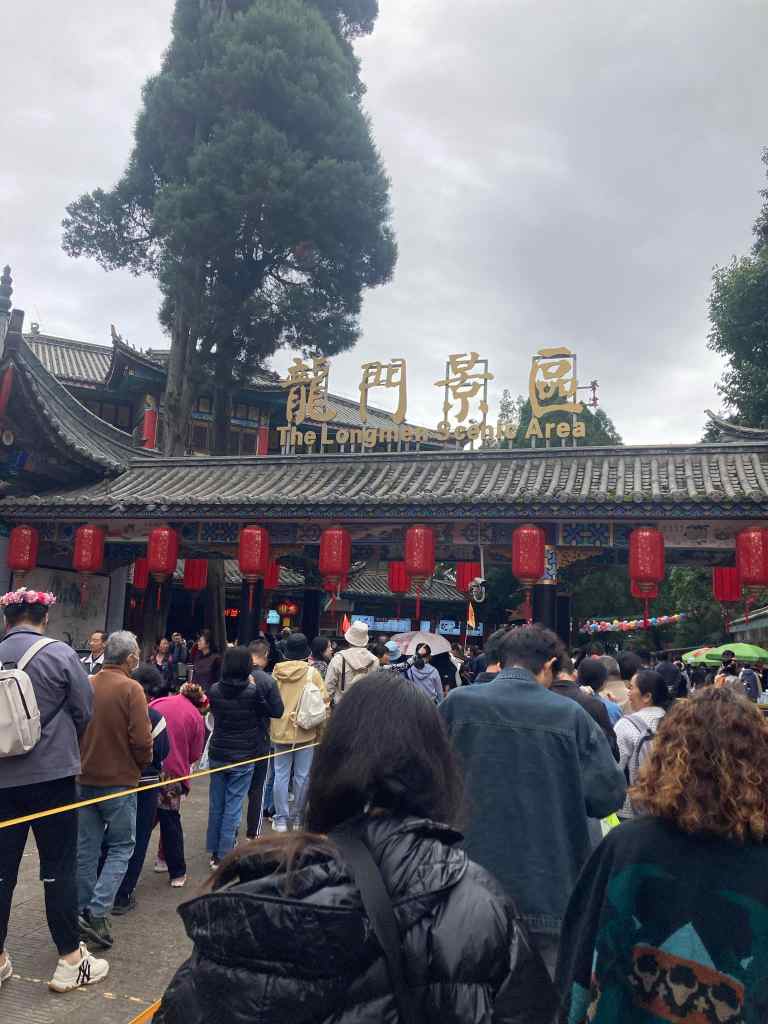
This is the shuttle bus stop area that takes you to the entrance area of the Xishan Dragon Gate.

This is the entrance area for the Xishan Dragon Gate. We were planning to take the lift up to see the dragon gate but we saw there was a long line so we decided to walk up first and we took the lift down on our way back.


The picture above, there are 4 Chinese characters written on the decoration which are “魚(fish)”, “躍(Jump up high)”, ”龍(dragon)” and “門(gate)”

My daughters showed me the mushrooms that they found on the ground. hehe Yunnan province is famous for the production of mushrooms. But I told them that they might not be edible one nor matsutake mushroom… hehe

When we visited the dragon gate, it was during a Chinese holiday, so the place was packed with local people who also traveled to the dragon gate. We tried to focus on walking up the steps one by one instead of complaining about how crowded it was. I think it is more important to think how you want to enjoy the time and think about how thankful you are to come to this place.
By the way, we have seen many designs and sculptures of koi fish and dragons in China. During the tour, our guide told us the story behind the koi and the dragon.
The next two pictures are not from the dragon gate, but I wanted to show you an example of what the tour guide told us.
So Koi live in a small pond where all the same fish are living. Koi will be always koi unless they try hard to jump out from the pond and against strong current of the river. If you want to see the other side of the world, you have to work hard and keep trying. So the dragon represents hard work and the success of your life.
After I heard about this story, I could understand why koi or goldfish with coins are in a water vase at the temple and the vase often has a design of dragons.

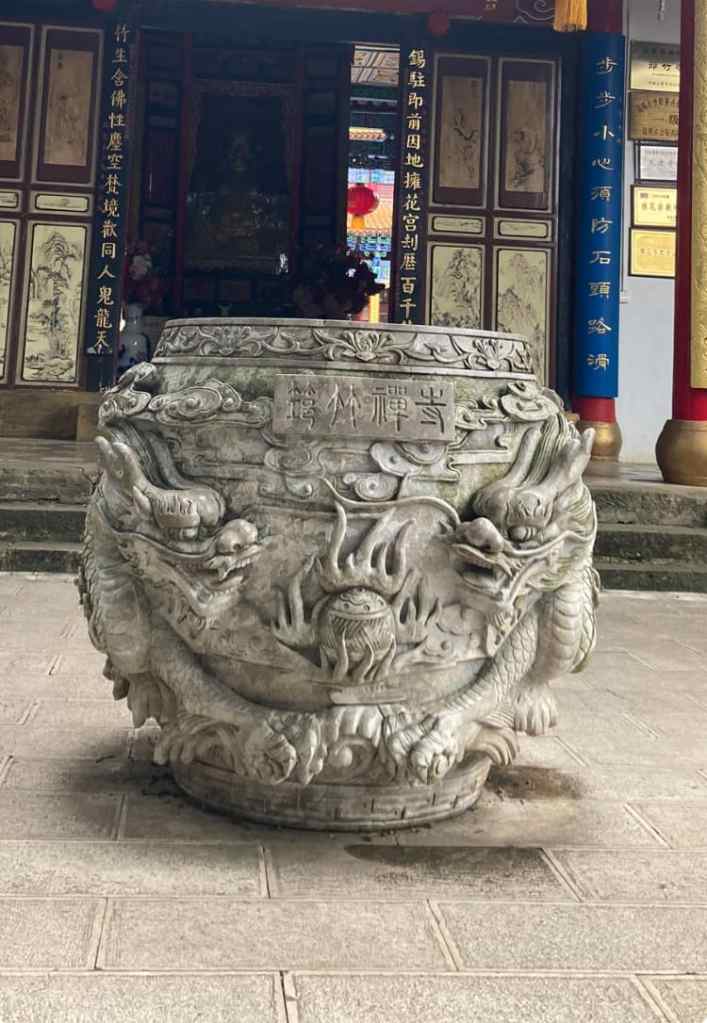
This picture above is not from the Xishan Dragon Gate (西山龍門), but I’ve seen the water vase designs with dragons a lot in China.

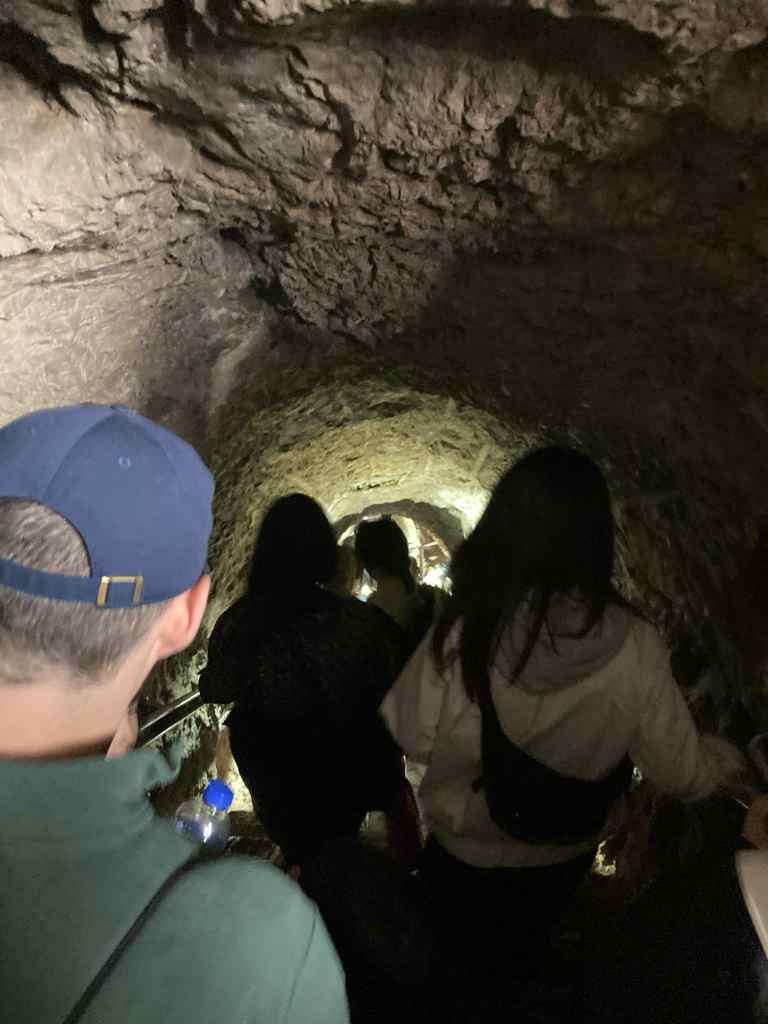
There are a hundreds of stone steps to climb until you can see the dragon gate. In the middle of the pass, there are several caves that are related to taoism.
In the picture below you can see when we finally arrived at the area after walking up hundreds of steps to see where the dragon gate was built. Look at our faces. We tried to smile but after the long walk, we could barely make a smile. hehe


The dragon gate on the cliff of Xishan(西山).↑
This is a cave where the god of learning is placed. On the right side, there is the dragon gate is located.

This is the god of learning. His right hand has a brush and his left foot keep a 升(masu) which is used as a scale for rice. It is said that the origin of this shape of god is based on the big dipper. In China, the star is known as emperor, a leading star since the others start to move along side of it. I was speechless when I saw this cave with carved beautiful scruptures and the magnificent scenery.


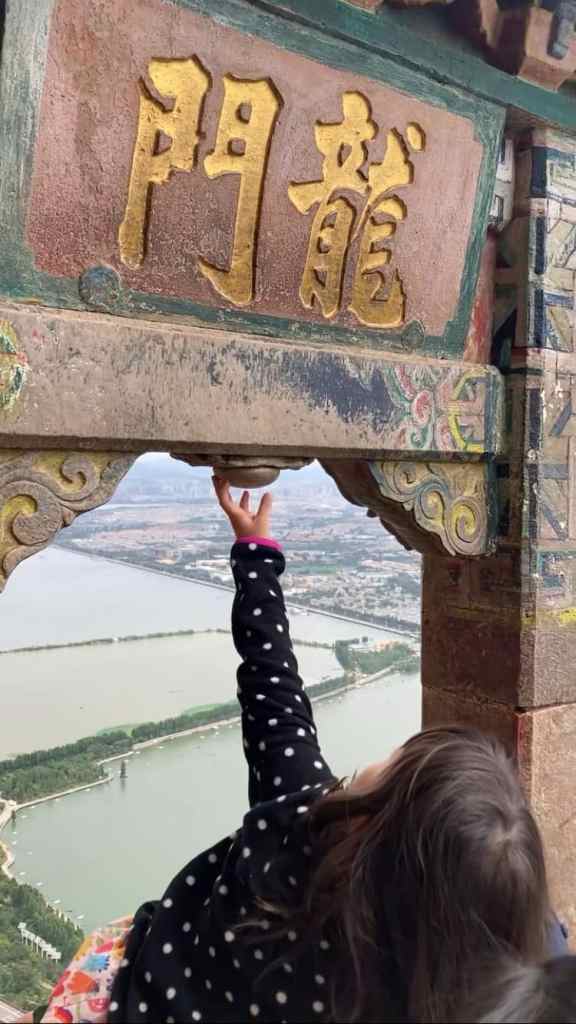
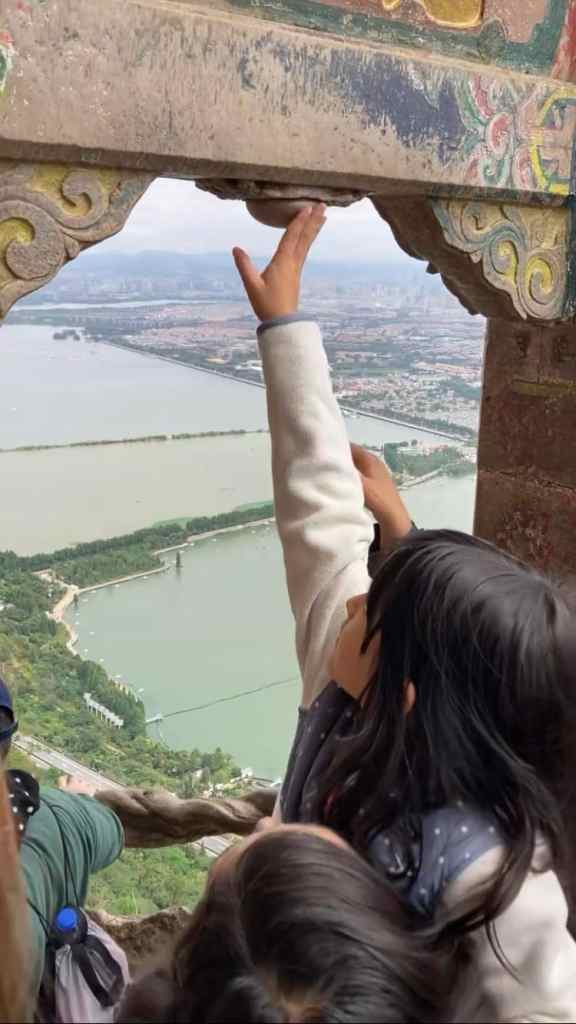
This is the dragon gate. There is a rounded decoration under the gate. It is believed that if you touch the dragon gate, you will pass the exam, get promoted and have a great career. Each of us touched the gate, of course!

On the left side of the dragon gate, there is Koi fish carved like the picture below.

There is a big dragon carving on the left side of the cave, where gods of study are placed.

After I heard a story about the koi fish becoming a dragon from our tour guide, I saw this dragon on the wall, and I felt deeply connected to the meaning of success and the gate (登竜門).

This is Kunming’s largest lake called “滇池(Diān Chí)” that we enjoyed seeing on our way back down the mountain with the ski lift.

The staff was taking pictures at the end of the lift. We bought the picture as a memory of our trip to the dragon gate!


Thank you for reading my blog!
 sachiwagashi.com